July 30th is the feast of St. Peter Chrysologus, bishop of Ravenna in Italy, who died around 450 AD. The prayer for his feast describes him as “an outstanding preacher of your Incarnate Word.” You can see why in this excerpt from one of his sermons:
“Why do you look down on yourself who are so precious to God? Why think so little of yourself when you are so honored by him? Why do you ask how you were created, and don’t want to know why you were made?
“This entire visible universe is yours to dwell in. It was for you that the light dispelled the overshadowing gloom; for you the night was regulated and the day was measured: for you the heavens were brightened with the brilliance of the sun, the moon and the stars. The earth was adorned with flowers, trees and fruit; lovely living things were created in the air, the fields, and the seas for you, lest you lose the joy of God’s creation in sad loneliness.
“And the Creator is still devising things that can add to your glory. He has made you in his image that you might make the invisible Creator present on earth; he has made you his legate, so that the vast empire of the world might have the Lord’s representative.
“Then in his mercy God assumed what he made in you; he wanted now to be truly manifest in men and women, to be revealed in them as in an image. Now he would be in reality what he was in symbol.”
The feast of Martha, Mary and Lazarus, the family at Bethany, (once feast of St. Martha alone) is celebrated on July 29th. The famiywere friends of Jesus, who gave him hospitality in Bethany. He blessed them with one of his most important miracles– raising Lazarus from the dead. The church wants us to see them all together, for Jesus affected them all by his presence.
The revision of the feast enforces the historicity of the gospel story. Jesus resided iwith them n Bethany when he came for the feasts. The present revision also brings Mary to where she belongs: she’s Mary of Bethany, not Mary Magdalene or the sinful woman who washes Jesus’ feet.
But Martha still stands out in today’s feast. The gospel readings from St. John and St. Luke feature her. Martha met Jesus when her brother Lazarus died and spoke those beautiful words of faith when Jesus asked if she believed he could bring life to the dead. “Yes, Lord, I have come to believe that you are the Christ, the Son of God, the one who is coming into the world.” ( John 11: )
Her faith was also the faith of Mary and Lazarus too. Jesus was at home with them.
Early Christians were curious about the fate of the family from Bethany, so closely linked with Jesus. What happened to them after he died and rose again? Nothing is said in the New Testament. One early legend sees them exiled in a boat at sea, eventually landing in France where they contribute to the conversion of that land.
Historians and blblical scholars today discourage stories like that. Better to stay with what the scholars tell us. But is our Christian imagination limited to what scholars say?
I hope not.
A favorite picture of the house in Bethany, by the 13th century Tuscan artist, Giovanni di Milano introduces this blog. Jesus is talking to Mary. The table’s set for four people. That would be Jesus, Lazarus, Mary and Martha.
But there’s a knock on the door and standing there are some of Jesus’ disciples, led by Peter. One of them gestures towards Peter, as if saying, “he told us to come.”
Poor Martha in her apron holds up her hands, “What am I supposed to do with them?” She is Martha who does everything and sometimes runs out of steam doing it. No matter how strong her faith, she is still Martha and this is her house.
There will be no miracle, except the miracle of Martha’s hospitality. More than four will be fed.
Not in the gospel, but our imagination, here led by an artist not a biblical scholar, tells us it could be.
Almighty ever-living God, your Son was welcomed to Bethany, Martha’s house, as a guest. Grant, we pray, that through her intercession and that of her brother and sister we may serve Christ faithfully in our brothers and sisters and finally be received by you into your heavenly home. Through our Lord Jesus Christ, your Son, who lives and reigns with you in the unity of the Holy Spirit, one God, for ever and ever.
Let my eyes stream with tears day and night, without rest, Over the great destruction which overwhelms the virgin daughter of my people,over her incurable wound.
If I walk out into the field, look! those slain by the sword; If I enter the city,look! those consumed by hunger. Even the prophet and the priestforage in a land they know not. (Jeremiah 14:17-24
Today’s first reading from our lectionary is a classic picture of the destruction of Jerusalem by the Babylonians in 598 BC, from the Prophet Jeremiah. The dead still wait to be buried, people are starving for food, prophets and priests wander about bewildered by what’s happened.
Just as important as the description of the devastated city is Jeremiah’s reaction to it. He’s no distant onlooker, he’s there, part of it all, and his eyes are filled with tears, day and night.
That’s Jeremiah. It’s his city and his people that have been struck “a blow that cannot be healed.” Instead of the Babylonians or the Judean leaders whom he had warned, Jeremiah addresses God. “You alone have done all these things.”
Does Jeremiah have something to say about our situation today?
“Nowhere else in the Old Testament does the eternal, invisible God become so involved in human experience and communicate within it as in the person of Jeremiah,” Fr. Carroll Stuhlmueller, CP, writes in his commentary on Jeremiah in the Catholic Study Bible.
Jeremiah struggles with God. He “paradoxically combines exceptional obedience to God with vigorous argumentation against God, he struggles with doubt and anger, and at times succumbs to them, only to be purified and transformed (Jer. 9:1; 15:19).”
There are no quick answers for him, Fr. Carroll writes: “The biblical message comes not simply as a finished polished discourse, but as an intuition, or to use Jeremiah’s words , as ‘fire burning in my heart, imprisoned in my bones’ ( Jeremiah 20:10). Jeremiah frequently provides us with a message on its way to becoming the final word of God, struggling to come to birth and seeming lost in the dark birth canal. “(Jeremiah, 20:17) (Reading Guide 304-305)
As we look at our own world in the grip of a devastating wars, climate change, global pandemics, what about Jeremiah’s words to God: “You alone have done all these things.”
Jesus answers the opposition described in chapters 11-12 in Matthew’s gospel with a series of parables we are reading this week. (Chapter 13) The seed doesn’t always fall on good ground, he reminds his disciples. Sometimes it falls on the path where it quickly dries up– like the towns that welcome him enthusiastically and soon forget him.
The parable of the weeds and the wheat points to enemies who want to poison the power and beauty of his words and deeds. The Pharisees and scribes, for example, did that.
The kingdom of God comes in smallness. It’s like the mustard seed, not a full grown tree. You can miss it if you’re looking for something fully grown and done. The treasure is hidden in a field; you may discover almost accidentally. (Monday, 17th week)
Did Jesus’ own extended family and his neighbors in Nazareth see him as just the little boy they knew before and couldn’t t appreciate him now? We underestimate small things and what they can grow to be. (Friday 17th Week)
But the kingdom of heaven is also like a merchant in search of fine pearls. You have to keep searching for it all your life. You can’t give up that search. Keep looking, hoping, searching.
Jesus concludes his teaching with the parable of the net cast into the sea that catches fish of every kind, good and bad. At the end of time, the net will be dragged to shore and the good will be separated from the bad. God is the ultimate judge, leave judgment to him. (Thursday, 17th Week)
The parables of Jesus are about the real world, the world Jesus experienced. They also help us look at the world we live in, which is not far from his.
Jeremiah the Prophet, Michelangelo, Sistine Chapel
For the next week or so, we’re reading the Prophet Jeremiah from our lectionary. Born about 650 BC, Jeremiah spoke to a nation in its final days before the Babylonians captured Jerusalem and took away its leading citizens into exile in Babylon in 598 BC. He looks downcast in Michelangelo’s portrait. He was.
Jeremiah wasn’t accepted during his lifetime. Discredited, arrested and imprisoned by his enemies, he urged religious reform and wise political alliances to Judea’s kings and leaders. His influence grew only after his death as the exiled Jewish community in Babylon reflected on his words and actions.
Jeremiah influenced the prophets Ezekiel, Daniel, Isaiah 40-66, and some of the psalms. He remained in Jerusalem after its destruction and later was forced into exile in Egypt where he died, but there is no information about his death.
Our reading for Thursday from Jeremiah is a good summary of his message to Israel:
You were “as a bride following me in the desert…I brought you to a ‘garden land’ which you defiled,” the Lord says to the people of Jerusalem. “Two evils have my people done: they have forsaken me, the source of living waters. They have dug themselves cisterns, broken cisterns, that hold no water. “ (Jeremiah 2:1-3, 7-8, 12-13)
A “garden land” — symbol for Jeremiah of God’s promise — comes from the Book of Genesis. God first gave humanity life in a garden. Now it’s offered again, but the “garden land” can be refused.
“Living waters” also is a favorite symbol of prophets like Jeremiah. The person who is just is like a tree planted by living waters, Psalm 1 says. A just people grow by God’s living waters.
“With you is the fountain of life, O Lord”, our responsorial psalm says today.
Jeremiah is mentioned in Matthew’s gospel when Jesus asks Peter “Who do people say I am?” They say you are Jeremiah or one of the prophets, Peter responds. (Matthew 16:14) Selections from Jeremiah are read in the lectionary in the 16th to the 18th weeks of the church year, year 2, as the readings from Matthew describe Jesus facing opposition as he begins his ministry in Galilee.
In lent and Holy Week we read Jeremiah as Jesus faces betrayal and death at the hands of his enemies.
Readings from Jeremiah occur in our Sunday readings, usually in the same context. He’s found also in the church’s morning prayers: Jeremiah weeps over a desolate land after Jerusalem’s destruction by the Babylonians. ( Jeremiah 3 10-14, Friday Morning, 3) The prophet proclaims God’s promise of a “garden land” . (Jeremiah 14 17-21, Thursday Morning 1)
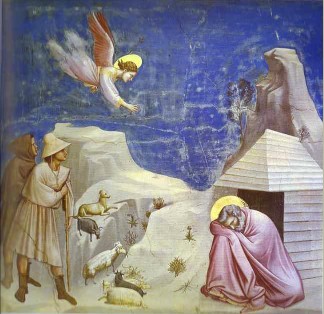
We celebrate the Feast of Ann and Joachim today, parents of Mary, the Mother of Jesus. The New Testament says nothing about them, but an early 2nd century document called the Gospel of James tells their story,
Ann and Joachim lived in Jerusalem, the ancient source says, where Joachim, a descendant of David and a wealthy man, provided sheep and other offerings for the temple sacrifices. The two had ties to Bethlehem nearby and Nazareth in Galilee.
They were well off but for twenty years disappointment clouded their marriage: they had no child. Even after vowing to dedicate their child to God, no child came. And so, at a time when children were treasured, they were thought poor. Descendants of David, they were blamed also for failing to continue the line the Messiah would come from.
Stung by criticism, Joachim spent more time in the mountains, brooding among the shepherds and their flocks. As her husband distanced himself from her, Ann too grew sad. God seemed far away.
In the garden one day, noticing some sparrows building a nest in a laurel tree, Ann burst into tears: “Why was I born, Lord?” she said, “birds build nests for their young and I have no child of my own. The creatures of the earth, the fish of the sea are fruitful, and I have nothing. The land has a harvest, but I have no child in my arms.”
At that moment, an angel of the Lord came and said, “Ann, the Lord has heard your prayer. You shall conceive a child the whole world will praise. Hurry to the Golden Gate and meet your husband there.”
At the same time, In the mountains an angel in dazzling light spoke to Joachim, “Don’t be afraid, the Lord hears your prayers. God knows your goodness and your sorrow and will give your wife a child as he did Sara, Abraham’s wife, and Hannah, mother of Samuel. You will have a daughter and name her Mary. Give her to God, for she will be filled with the Holy Spirit from her mother’s womb. Go back to Jerusalem. You’ll meet your wife at the Golden Gate and your sorrow will turn into joy.”
Joachim and Ann met at the Golden Gate to the temple, the place of God’s presence. They embraced as they spoke of the angel’s promise. Returning home, Ann conceived and bore a daughter, and they called her “Mary.”
When she was three years old, Ann brought Mary to the temple to learn the scriptures, to pray and take part in the Jewish feasts. She watched her father bring lambs to be offered in sacrifice. She grew in wisdom and grace in God’s presence.
When Mary approached marriage age– then 15 or so–her parents arranged for her marriage as it was customary. They sought the high priest’s advice, tradition says, and Joseph of Nazareth was chosen as her husband. Nazareth was then their home.
The angel Gabriel appeared to Mary and announced that she was to be the Mother of Jesus. By the power of the Holy Spirit she conceived the Child.
After Jesus was born in Bethlehem, Mary and Joseph returned to Nazareth where Jesus grew up. He was raised in a large extended family that included his grandparents, Ann and Joachim, who cared for him as a child.
No one knows just when or where Ann and Joachim died, but Jesus must have treasured them in life and on their passage to God.
The 2nd century Protoevangelium of James repeats a fundamental theme of the Book of Genesis: God promises Adam and Eve many children who will enjoy the blessings of the earth. God repeats the promise to an aged, childless couple, Abraham and Sarah, and again to Hannah, who bemoans her childlessness to the priest Eli in the temple. In the same way, God gives a child to Ann and Joachim. Mary, their daughter, brings blessings to the nations through her son Jesus Christ, born of the Holy Spirit.
Giotto’s 14th century illustrations (above) from the Arena Chapel in Padua. helped popularize the story of the parents of Mary in Italy, Europe and the rest of the western world.
It’s an important story for grandmothers and grandfathers. Like Ann and Joachim they have a big role raising the next generation. More than they think.
The mother of the sons of Zebedee approached Jesus with her sons and did him homage, wishing to ask him for something. He said to her, “What do you wish?” She answered him, “Command that these two sons of mine sit, one at your right and the other at your left, in your Kingdom.” Jesus said in reply, “You do not know what you are asking. Can you drink the chalice that I am going to drink?” They said to him, “We can.” He replied, “My chalice you will indeed drink, but to sit at my right and at my left, this is not mine to give but is for those for whom it has been prepared by my Father.” When the ten heard this, they became indignant at the two brothers. But Jesus summoned them and said, “You know that the rulers of the Gentiles lord it over them, and the great ones make their authority over them felt. But it shall not be so among you. Rather, whoever wishes to be great among you shall be your servant; whoever wishes to be first among you shall be your slave. Just so, the Son of Man did not come to be served but to serve and to give his life as a ransom for many.” (Matthew 20:20-28)
James and John were sons of Salome and Zebedee, the gospels say, and at the Sea of Galilee Jesus called them to follow him. They were fishermen, relatives of Jesus. The gospels mention James first; he may have been the oldest.
The two brothers are described as quick-tempered and ambitious about restoring Jewish independence. They became part of the innermost circle of Jesus’ companions. They heard him teach, saw him transfigured in glory, then shaking with fear in the garden of Gethsemane before his death.
Our first reading at Mass for the Feast of St. James is a good description of James and John. “We hold this treasure in earthen vessels, that the surpassing power may be of God and not from us.” (2 Corinthians, 4,7) James and John were earthen vessels indeed, as our gospel describes them, using their mother Salome as their intermediary, looking for a big place in the kingdom they hope Jesus will bring. Earthen vessels break easily.
Jesus asks them if they can drink from the chalice that he will drink from, the chalice of serving others, no matter what the cost. “We can,” they say.
His brother John and his mother Salome stood near the cross of Jesus, but James must have fled immediately when Jesus was seized in the garden. Yet, God’s “surpassing power” filled him with treasures of faith, and James drank from the cup he asked to drink.
According to the Acts of the Apostles, James spoke bravely about Jesus risen from the dead to the people of Jerusalem and to the Jews visiting the Holy City from all parts of the world at Pentecost. He became a leader of the Jerusalem church but probably still clung to dreams of Jewish independence. Long held dreams don’t easily disappear.
In the year 41, Herod Agrippa, the grandson of Herod the Great, became king of Judea and ruled in Jerusalem. Educated in Rome, he knew how to favor the emperors of his time and he also knew how to please the powerful Jewish ruling class that had a key role in his kingdom. Were they also concerned about James’ continued political hopes for a Jewish kingdom?
When the Jewish Sanhedrin accused Christians of threatening the peace of Jerusalem, Herod sent his soldiers to seize James, the son of Salome and Zebedee, and had him executed by the sword. Strike the shepherd, Herod reasoned, and the sheep will scatter.
James, son of Zebedee, was the first of the apostles to die a martyr’s death. “My cup indeed you will drink,” Jesus promised, and his promise came true.
On the list of apostles there is another James, son of Alphaeus, commonly called James the Less. He is thought to be the son of Mary of Clopas, a sister of Mary, the mother of Jesus, who stood beneath the cross of Jesus with Mary Magdalen. (John 19: 25) His feast, along with the Apostle Philip is May 3. He was head of the church in Jerusalem and was martyred there in 62.
Born in Lebanon, Sharbel Makhlouf was brought up in a tight knit village community high up in the mountains by an uncle who didn’t approve of his love of prayer and solitude and had other plans for him. Sharbel broke from family and village to enter the monastery of St. Maron where he became a monk and then a priest.
Then, following the example of the desert saints, Sharbel became a hermit, distancing himself further for the next 23 years from the society he lived in.
But like the desert saints– like St. Anthony of Egypt who attracted others into the desert by his life of prayer and solitude– Sharbel became a trusted guide and friend to those who came to the small rooms he provided in his hermitage for those seeking his wisdom.
They found him free from the lure of success, the love of money, the demands of society and family expectations. He reminded them of what’s above all: Love God and love your neighbor as yourself. Moslems as well as Christians sought him out and honored him. He is an important source of unity in a region, Lebanon, where the two worlds live closely together.
Many miracles occurred after his death. Pope Paul VI said of him at his canonization in 1988: ” May he make us understand, in a world largely fascinated by wealth and comfort, the paramount value of poverty, penance and asceticism, to liberate the soul in its ascent to God.” Pope Leo chose Lebanon as one of the first churches to visit after becoming pope.
The Maronite Church has always been an eastern Christian church allied to Rome.
“Explain to us the parable of the weeds in the field, ” his disciples ask Jesus. (Matthew 13:36-37) Why do they want him to explain this parable about the weeds in the field before any other parable, we wonder ? What’s so important about it?
The parable, about a man and his servants who plant wheat, immediately follows Jesus’ opening parable of the sower in Matthew’s gospel. Once the wheat’s planted, they’re ready to go to sleep. All’s done; they have only to wait for the harvest.
But it won’t be so: an enemy comes and plants weeds in the wheat field. You can hear the servants’ distress as they wake up to it. They weren’t expecting this. Their immediate response is to go and pull the weeds up.
Like the rocky ground Jesus describes in the parable of the sower, they hear the word and receive it with joy, but “when some tribulation or persecution comes because of the word” they fall away. (Matthew 13:20-21) They’re overwhelmed by the sight of weeds.
Were Jesus’ disciples like them at this point in Matthew’s gospel? The pharisees were bent on putting Jesus to death. They’ re joined by the Herodians, the followers of Herod, ruler in Galilee. The cities that first received Jesus with joy now are rejecting him now. His own family wish him to abandon his mission.
His disciples envisioned a wheat field; now they see a world of weeds. And so they ask Jesus: what’s this is all about?
Not just Jesus’ immediate disciples wonder about what they’re seeing, others do as well. We celebrate the Feast of the Apostle James July 25th. , Matthew described the mother of James and John appealing to Jesus for a privileged place in his kingdom. She saw a wheat field on the horizon. Jesus reminded her and her sons it’s a field of weeds as well.
Perhaps Matthew’s gospel also has the Galilean world of his day in mind, where the disciples of Jesus become overwhelmed by a resurgent Judaism led by the pharisees? Let’s go further; as we see today a church in decline in the west and a world split into factions, do we have a similar vision of things? We live in a field of weeds!
Parables raise questions and give answers. The parable of the weeds and the wheat proclaims, first of all, God’s confidence in the seed he has sown. Our world will never be a perfect wheat field, but it won’t become a field of weeds. We can’t eradicate every evil we see. As Jesus teaches today: we have to leave this world to the judgment of God.
The parable calls into question the way we look at life. Just weeds? No wheat? Or do we see both. Do we trust in the Sower who has sown wheat?
As we read this parable, the Lord comes to us as wheat. Ignatius of Antioch once said “I am God’s wheat.” And so are we.